A Conversation with
Jay Parini
On mining country, the notebook practice, and poetry's conversation with silence.
Poetry is always in conversation with silence. It arises from a certain stillness — like the darkness eventually in the morning crumbles into daylight. It's a slow process.
— Jay Parini
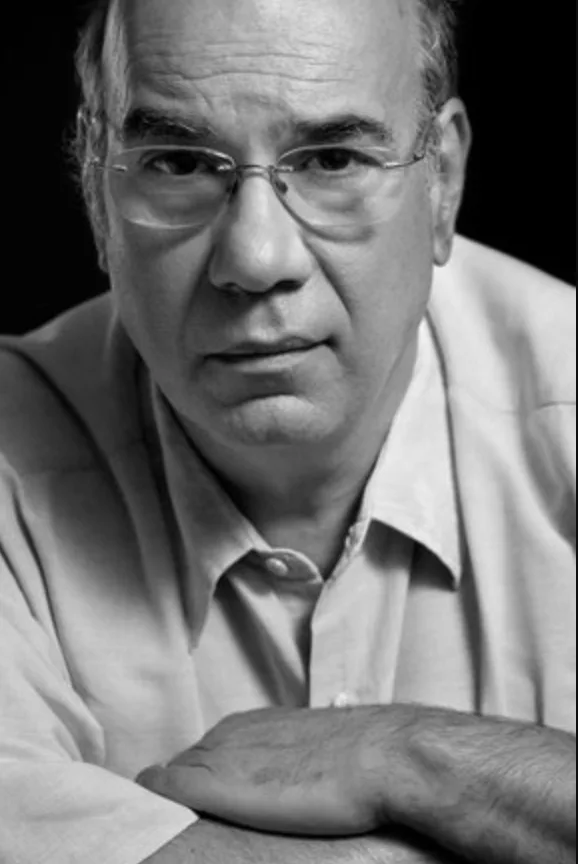
Photo · Oliver Parini
Subject
Jay Parini
Poet · Novelist · Biographer
Middlebury College, Vermont
Jay Parini is the author of numerous collections of poetry, several novels, and major biographies of Robert Frost, John Steinbeck, William Faulkner, and Gore Vidal. He has spent forty years at the center of American literary life — a friend of Seamus Heaney, Robert Penn Warren, Richard Wilbur, and James Merrill. He teaches at Middlebury College in Vermont, where Robert Frost's shadow still falls across the fields.
Damon King sat down with Jay Parini on the occasion of his collected poems — forty years of work gathered into a single volume. What followed was a conversation about the mining landscapes of northeastern Pennsylvania that made him a poet, the notebooks he has kept for half a century, the friends who shaped his voice, and why reading poetry is an act that requires the one thing the modern world refuses to give: silence.
You've had several volumes of poetry. This one gathers work from 1975 to 2015. What makes it different?
This is every book I want to stand by over the forty years I've been writing seriously and publishing poetry. It contains the last ten years' work — a sequence called West Mountain Epilogue, brand new, never before seen — and then I gather together all of my work over the thirty years before that. Pretty much the very best ones.
Of all the things you do — novels, biographies, poetry — is there one you particularly love most?
Over these forty-five, fifty years, poetry has been at the center of my writing life. Not a week goes by. Everything else comes after that — the novels, the biographies of Frost, Steinbeck, Vidal, Faulkner. Poetry is me finding a voice at its deepest level. Finding that voice in the poems allows me to write in a centered way, to make the voice real and authentic.
Have you ever run into writer's block?
I once asked William Stafford if he ever suffered from writer's block. He said, no, I just lower my standards. And I think I just do that. When I'm writing poetry, I can always find something. I can go low enough if I have to, find where I really am emotionally, intellectually at that moment. I write poems — mostly fragments — in my notebooks every day. I've kept hundreds of notebooks over the years. My writing day begins with putting up my poetic notebook, working with a pencil, blank page. That visceral connection between the hand, the page, and the word makes it authentic.
I can go low enough if I have to, find where I really am. The writing day begins with a pencil and a blank page — that visceral connection between the hand, the page, and the word.
Are there pieces from years ago — unfinished — that you go back to and complete?
I wrote a couple of stanzas of one poem in 1960. Every five or six years over the decades I would return to it and try to pawn it, find where it was. I really only finished it last year. It's in this book now — called Lament of the Middleman. Forty-five years of work, going back to it again and again. When I see those lines, I see myself at twenty-two, and I know what I was trying to dig for. Now I have the additional decades of experience. Sometimes I can actually finally dig out what I was looking for.
You have a deep affinity for mining country in your poems. Tell me about that.
My mother and grandfather were miners in northeastern Pennsylvania. I grew up in West Scranton. There were abandoned coal breakers, mine shafts everywhere — culm dumps, the coal waste, lying around my house giving off sulfurous fumes. Decade after decade at night they would glow a vermilion color. The landscape of my early childhood made a vivid impression. The day I graduated from high school — June 10th, 1966 — I was about to give a talk to my graduating class about the history of mining in Lackawanna County. That afternoon we got the call that my uncle Gene, thirty-two years old, had been crushed in the mine. It was a rather devastating day. I've been thinking about those mines ever since. I try to explore the metaphorical weight of this image as well as its literal, realistic truth.
Playing in the Mines — recited from memory
Never go down there, fathers told you, over and over. The hexing cross nailed onto the door read DANGER, DANGER But playing in the mines once every summer, you ignored the warnings. The door swung easier than you wished; the sunlight followed you down the shaft a decent way. No one behind you, not looking back, you followed the sooty smell of coal dust, close damp walls with a thousand facets, the vaulted ceiling with its crust of bats, till the tunnel narrowed, and you came to a point where the playing stopped. You heard old voices pleading in the rocks; they were all your fathers, longing to fix you under their gaze and to go back with you. But you said to them NEVER, NEVER as a chilly bile washed round your ankles, You stood there wailing your own black fear.
Listen — Jay Parini reads Playing in the Mines
That poem is stated in my head — I have it memorized. It's about going into the mines as a kid. I used to, once or twice a summer, open the door and walk as far as I could into one of those abandoned mine shafts near my house. I wrote it later in life when I was thinking about Dante and Virgil going into the underworld, reading the Odyssey, reading about Odysseus going to find his father. These are archetypal images. They're literal. But they're also that.
There are people on the jacket of this book — James Merrill, Richard Wilbur. Are there poets who have particularly shaped you?
Merrill was an old friend, and a genius. Wilbur was a great inspiration. I was influenced by Robert Penn Warren — I used to spend hours walking in the woods with Warren talking about poetry, its effects on people, how one writes. When I was a young man in Scotland, I met Seamus Heaney, the great Nobel Laureate, and we had a forty-five-year conversation. He came to visit me in Vermont not long before he died. I've been rubbing shoulders with some very fine poets over the years — Anne Stevenson, Julia Alvarez, who is my next-door neighbor in Vermont. We talk at dinner at least once a month. And Neruda. I went to three of his houses in Chile. He writes such beautiful love.
Who is the quintessential American poet?
Robert Frost — the great American poet of the twentieth century. I go back to Frost again and again. Of course, I live in Vermont. Frost walked around with a nature Bible — the cows, the apple picking, the seed behind me where I live. I had a wonderful teacher in high school, Miss Mayer, who put Frost in my hands at eighteen years old. My parents took me to Vermont to see where Frost lived. He has been a continuing part of my entire life.
Why is poetry important? You've written about this.
Poetry is essentially the language that people go crazy for the lack of. People go to psychiatrists now, to try to find language adequate to their lives. Poetry is that language. Great poets — Elizabeth Bishop, Auden, Frost — they know what words come from, what their Latin and Greek roots are, and they see the image at the center of every word. Every word. Poets are people who are very attentive not only to words and their meanings, but to their linguistic roots, their philological depths.
People go to psychiatrists now, to try to find language adequate to their lives. Poetry is that language.
Does reading poetry take a certain kind of maturity? A certain process?
It's not hard at any age if you can have the maturity to sit still and listen. We live in such a bustling world. People don't have the habits of silence, the habits of still reading, slow reading. They read too quickly. They're so used to static they don't know what silence sounds like. Poetry is always in conversation with silence. It arises from a certain stillness. It goes from a fleet absence of stillness very slowly — sort of leaking in, like the darkness eventually in the morning crumbles into daylight. It's a slow process.
What is next for you?
I'm sixty-eight years old. I hope I can keep writing poems and find some good ones in the next few years. I'm working on a novel about the life of the Apostle Paul. I've just finished a screenplay about the life of Gore Vidal. I'm just doing different kinds of things — reading and writing and trying to keep doing it for a while longer while I'm conscious.